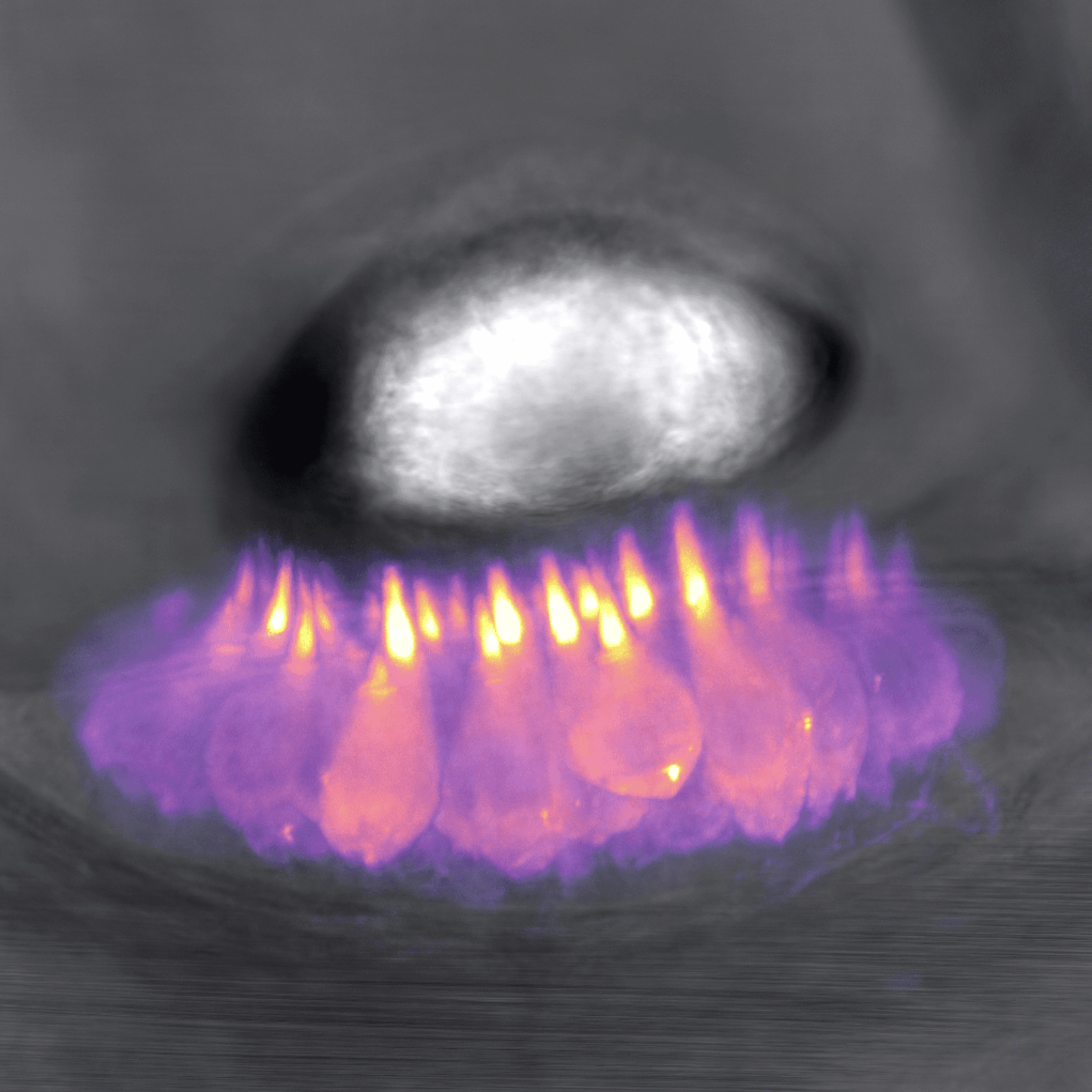
Our First Confocal Images!
Captured with Nikon X1 and NSPARC.

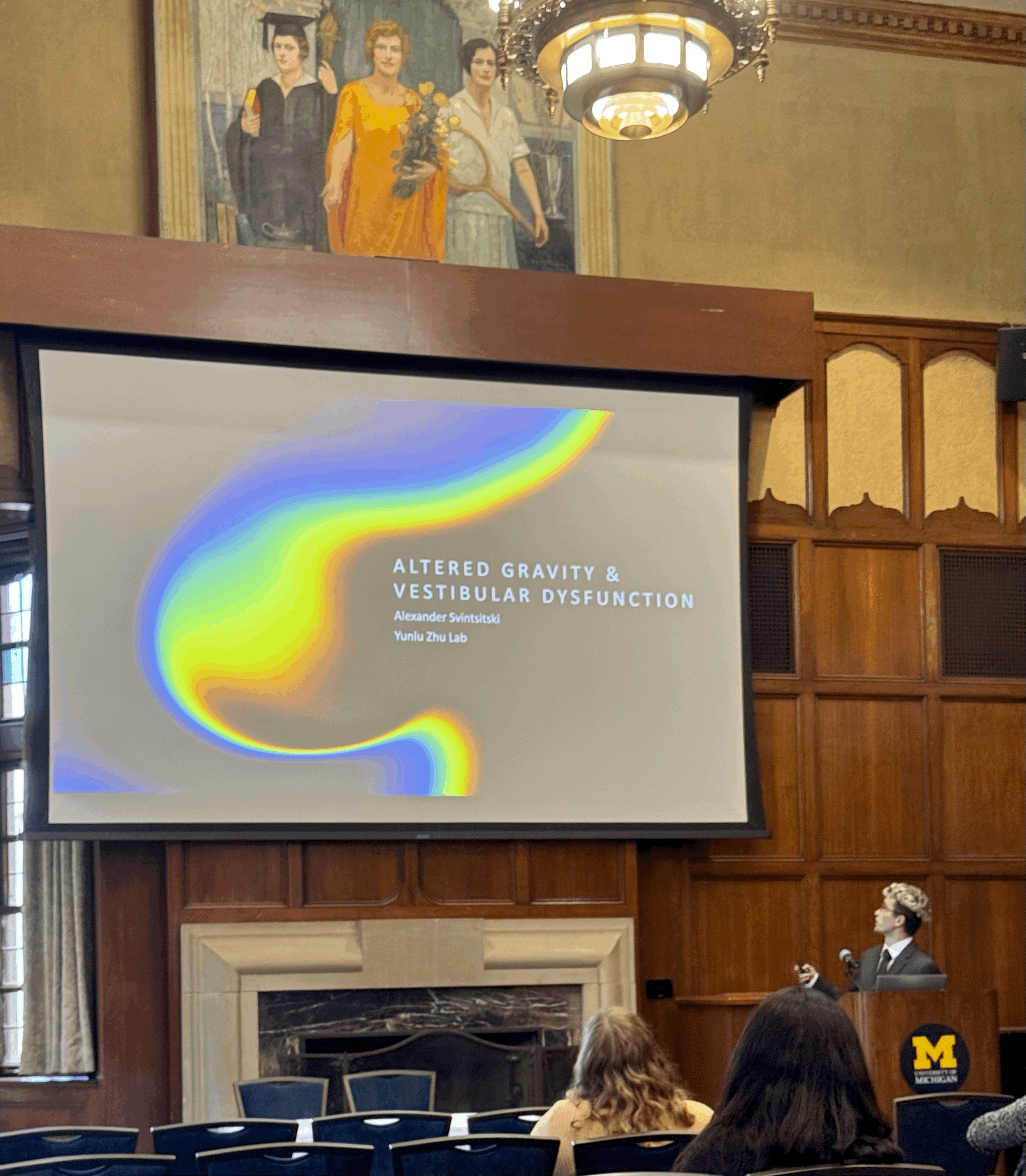
Alex won the Blue Ribbon!
Congratulations to Alex on winning the Blue Ribbon at the UROP Summer Research Symposium for his presentation "Altered Gravity & Vestibular Dysfunction" 🎉🌟
We've joined the Kresge Hearing Research Institute!
Learn more about Yunlu and the lab in the Department of Otolaryngology news feature!
Read the full story below:
—
We are thrilled to welcome Yunlu Zhu, PhD to our Kresge Hearing Research Institute as an assistant professor of otolaryngology-head and neck surgery. Dr. Zhu is the Terry and Shelly Barr Research Professor through the Michigan Neuroscience Institute, as well as an assistant professor of molecular and integrative physiology.
He earned his PhD in biology from the University of Virginia and completed his postdoctoral training at the NYU Grossman School of Medicine, where he was recognized as the Leon Levy Neuroscience Fellow and a Rainwater Tau Leadership Fellow.
Tell us about your research interests and what drew you to them?
My lab studies how the brain transforms vestibular signals into precisely coordinated movements that maintain balance, using zebrafish as a model system. We combine genetics, functional imaging, behavioral analysis, and computational modeling to understand how neurons and glia shape balance function, how vestibular processing integrates information from other sensory systems, and how disruptions in these circuits lead to balance deficits. Ultimately, our goal is to understand why balance fails in disease and injury, and how it can be restored.
What drew me to this field is that the vestibular system is both fundamental and surprisingly underappreciated. Nearly every vertebrate relies on it, yet most people never think about it until something goes wrong. Despite the enormous diversity of movement across species – fish swimming, amphibians crawling, mammals running, and humans walking upright – all of these behaviors depend on the same basic sensory organ in the inner ear that detects acceleration and helps stabilize posture and gaze. I find it fascinating that such a conserved sensory system can support such a wide range of motor behaviors, and I am interested in understanding how the brain transforms vestibular signals into pre-motor activity that can generate diverse behaviors.
What do you find to be the most challenging and rewarding aspects of working in vestibular science?
It is particularly rewarding to be able to quantify behavior, reduce it to measurable parameters, and then link those parameters to the activity of a specific population of neurons in the fish brain that is evolutionarily conserved in humans. Building on this foundation, we use disease models to investigate how the function of this neuronal population is disrupted and how those disruptions ultimately give rise to behavioral symptoms. At the same time, this is also the most challenging aspect of the work, because connecting changes at the cellular level to complex behavioral outcomes requires integrating evidence across multiple scales of analysis.
Why did you choose to come to the Kresge Hearing Research Institute?
I came to KHRI for the science and the people. The research here is exciting, and I think it is an environment where I can thrive and contribute. Just as importantly, I was impressed by how welcoming and thoughtful everyone was. I’m excited to work with such great colleagues and with the students here.
Is there anything you’re excited to do or experience in Ann Arbor or Michigan?
I’m new to Michigan, so I’m looking forward to exploring parts of the state that are very different from places I’ve lived before. I was excited to learn that we have several dark-sky preserves (Keweenaw Peninsula, Headlands, Dr. Lawless Park etc). Another destination high on my list is the seemingly remote Isle Royale National Park.
What do you like to do outside of work or what are favorite hobbies?
I enjoy coffee, especially light roasts, as well as Asian teas. I also do pottery, play traditional woodwind instruments such as low Irish whistle, and practice Tai Chi Quan. I go bouldering occasionally, enjoy reading sci-fi and natural science books, and have a soft spot for fountain pens, handwriting, & journaling. But lately, as a first-time homeowner, many of these hobbies have had to compete with an endless list of home improvement projects.
Favorite music genre or artist?
Classical music (symphonies, concertos, piano and violin solo works, and almost everything from JS Bach), Irish music, sometimes bluegrass, “world” music, and microtonal/atonal/contemporary stuff. I also love the musical Hadestown – if you haven't seen it, go watch it!